by Cieslafdn | Aug 17, 2011 | Rosenwald Fund
The first few decades of the 20th century saw huge numbers of African Americans moved to the Midwest during a period that is now called “The Great Migration.” Midwestern cities like Detroit, Cleveland, Cincinnati and St. Louis saw their black populations swell as more and more black people migrated to them from the South. These cities became the focal point of African American life and the most important of all these cities was Chicago.
Despite the fact that many business in Chicago benefitted from black labor the city was unprepared and in many cases unprepared to house this large population of southern blacks. Many white Chicagoans greeted the huge numbers of southern black people with contempt. Moreover, Chicago simply did not have the housing to accommodate this huge new population. The overcrowding caused by the huge influx in the black population, many of whom were prevented from getting housing due to the fact Chicago was segregated, and the competition with other ethnic groups in Chicago—the Irish in particular, lead to significant racial tension. This racial animosity eventually manifested itself in the 1919 Chicago Race Riots, in which nearly 50 people died, hundreds were injured, and perhaps as many as one thousand people were left homeless the vast majority of whom were black.
It was in the context of both the racial tension and the systemic housing crisis faced by the now large black Chicagoans that Julius Rosenwald came up with a plan to develop an apartment building for middle and working class black people. Rosenwald first publicized his idea to build an apartment building for black people in July of 1928. The complex, which was to be called the Michigan Boulevard Garden Apartments, was located in the heart of South Side Chicago in a place known as the “Black Belt.” The apartment building spanned from 47th to 46th street between Michigan and Wabash Avenues, and was located right in the middle of a vibrant black community.
Julius Rosenwald had his nephew Ernest Grunsfeld design the building. The inspiration for the design of the apartments may have come to Julius Rosenwald during a trip to Vienna inn 1926. Like the apartments he saw on his trip he decided to build his apartment using the innovative idea of having shops on the first floor and the apartments above them.
The building is an enormous 465,544 square feet, 16,400 of which are commercial space. There were originally 421 apartments that ranged from 3 to 5 rooms. The Rosenwald had more than 1150 windows and more than a half dozen entrances. There were no elevators (this would become a major problem for future renovations) so residents living at the top had to walk up all 5 floors. In the center of the complex is a large courtyard with garden and a fountain. The total cost of the apartments was 2.7 million dollars.
The decision to build this apartment building was far more than simple altruism. Rosenwald had a friend named Benjamin Rosenthal who was a real estate developer and in 1916 had tried to sell cheap housing to people of different ethnicities, European immigrants principally. Rosenthal had hoped to make a profit off of it despite the cheap rent, and ultimately Julius Rosenwald was convinced to get involved. While the project was a failure, Rosenwald did not abandon the idea that you could provide cheap housing that would be profitable. Rosenwald’s desire for the building to be profitable was not purely for personal gain. He hoped to show other whites that such ventures to help blacks could be provided by the private sector and still be profitable.
The Depression however may have cost Julius Rosenwald the financial side of this vision. Even though rents were already well below market rate they were still too expensive for residents. Yet soon after the apartment complex opened the property managers were flooded with applicants hoping to move into the apartment complex. Besides the fact that the apartments were cheap they were also safe. Children played in the courtyards while the parents could shop at the conveniently located storefronts. The apartment complex was its own little community and became the backbone of the commercial sector on 47th street. In the 30s, 40s, and 50s, the apartment complex became a major nexus of black life and culture in Chicago. Jazz legend Nat King Cole, the poet Gwendolyn Brooks, one of the greatest boxers in history Joe Louis and 27time Grammy winner Quincy Jones.
Over the years however the apartment complex came to fall under hard times. In 1956 the longtime manager Robert Taylor was unable to get enough support to transfer the complex into a cooperative. The fortunes of the building trended steadily southward after that. The building deteriorated and became increasingly dangerous in proceeding decades. The Urban League, with the help of a developer, rehabilitated the apartments during the 1980s but safety hazards during the 1990s and early 2000s caused the Rosenwald to be vacated.
The building has been empty for over a decade now and the conditions of the dilapidated building have gotten even worse. The vacant Rosenwald apartments have become a hotspot for crime. There are a number of groups currently trying to renovate the building but the costs of such repairs would be enormous. The cost of repairs might run as high as $150,000,000. Many of the plans to rehabilitate the Rosenwald have failed because of the high costs and complex challenges of updating such an old building to meet modern disability and city codes. Some want to demolish the building, but due to its rich history many believe that it would be a travesty to destroy the Rosenwald.
As government housing projects have fallen into disarray and their utility has drawn increasing skepticism and gentrification has forced many middle and working class black people out of their neighborhoods, the Rosenwald apartments take on new significance. The future of the building is unclear buts its legacy is not. For a time it was the heart of one of the most vibrant and talented black communities in world and a number its residents went on to become icons in American culture. The building stands as a testament to Julius Rosenwald’s ambitious altruism and entrepreneurial spirit.
by Cieslafdn | Aug 17, 2011 | Rosenwald Fund
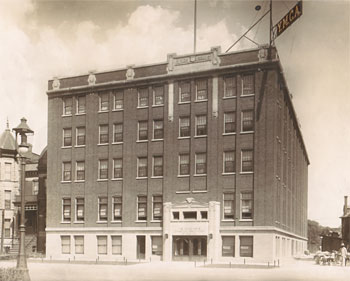
The creation of the Rosenwald Schools was Julius Rosenwald’s most enduring act of philanthropy in the African American community but it was not his first. In 1910, two years before he began working with Booker T. Washington to build black schools in the South, Rosenwald was involved in a variety of efforts to address the issues faced by the black community in Chicago. The construction of the Wabash YMCA in Bronzeville was one earliest of these efforts and one of the most important.
The building of the YMCA occurred during a time in Rosenwald’s life when his concerns about racial injustice were just beginning to coalesce. In 1910 Paul J. Sachs sent Rosenwald copies of Booker T. Washington’s autobiography Up From Slavery and John Graham Brook’s An American Citizen: The Life of William H Baldwin Jr. This proved to be a galvanizing moment in Julius Rosenwald’s life. After reading these books Rosenwald felt compelled to address the social and economic inequalities that plagued African Americans.
When Rosenwald was approached by Wilbur Messer, the general secretary of the Chicago Branch of the YMCA, in 1910 about building a black YMCA Rosenwald was so inspired by these books that he gave a $25,000 donation to help build a YMCA for African Americans in Chicago. He also promised to give $25,000 to any community in the country that wanted to build a black Y and could raise $75,000. Rosenwald also required that a substantial portion of this money had to come from the black community because he felt that it was important for black people to play an active role in the process; Rosenwald was ideologically opposed to handouts of any kind. Within a year Los, Angeles, Washington, D.C., Indianapolis, Atlanta, Philadelphia and of course Chicago had all met Rosenwald’s demands and were in the process of building black YMCA’s—all of the cities would eventually build the Y’s though it would take some cities more than a decade.
There were two principle reasons why Rosenwald supported the construction of the YMCA. For one, Rosenwald had made contributions to local Hyde Park YMCA for a number of years and had long been a supporter of the organization. Moreover, at this time many if not most YMCAs in both the North and the South were segregated, and there were few recreational and community centers for blacks. Rosenwald realized that the creation of a YMCA for African Americans was a practical way that he could improve the lives of ordinary black Chicagoans.
Despite the fact that the Y was segregated–an integrated YMCA at this point in time probably would have been impossible—Julius Rosenwald truly believed that the Y could be a stepping stone to better relations between blacks and whites. Julius Rosenwald gave a speech during the opening YMCA where he spoke about the importance of overcoming racism. “The man who hates the black man because he is black has the same spirit as he who hates the poor man because he is poor. It is the spirit of caste. I am the inferior of any many whose rights I trample underfoot.” A year later he would echo that statement in an article for the YMCA newsletter in which he claimed that the partnership of blacks and whites to build the Y was “evidence that the contact of the white and Negro races will surely lead to a better understanding of both.”
Soon after the Y opened it became essential to the black southerners that came to Chicago during the Great Migration. The Wabash Y was built during the beginning of the First Great Migration where more than one million African Americans left the Jim Crow South to move to the North. These African American migrants settled in urban centers both in the Northeast corridor and in the Midwest. Huge numbers of African Americans ended up in Chicago because of the industrial job opportunities and its location on the railroads (African American migration can be traced along the railways). Many white Chicagoans were hostile to blacks—this hostility reaches its apex in the Chicago Race Riots of 1919. In this context the Wabash Y’s most important function was to ease the difficult transition of these newly arrived black migrants.
Over the years the Wabash YMCA became haven for African American Chicagoans and was a vital community institutions. Inside the Y blacks could escape from their hardships and participate in the wide variety of educational and recreational activities. Black patrons attended lectures, bible studies, music performances, and played athletics. Great athletes such as Joe Louis would train in the YMCA, which provided some of the only athletic facilities to blacks and often was often the center of organized sports.
However the Y was utilized for much more than leisure; the Y provided a number of essential services to the residents of Bronzeville. Many black workers received their paychecks at the Y. There were no hotels in Bronzeville so black visitors and people who did not have any other place to stay were able to take refuge in the Y. The Y also offered professional training to black migrants, most of who had been involved in agriculture and needed to learn new skills in order to gain employment in industry. During the Chicago Race Riots The Y administered aid and shelter to the black people who were injured or were in need of refuge.
The Wabash Y also became an important part of black intellectual culture in Chicago. It houses a mural painted by William Edouard Scott, one of Chicago’s most important early 20th century black painters. Moreover it was at this YMCA where Carter G Woodson created the Association for the Study of Negro Life and History: a pioneering organization that studied African American History and the conditions of black people. Woodson and the Association would be instrumental in the creation of Black History Month in 1926.
Like the neighborhood in which it was located the Wabash Y fell under hard times during the 1970s and eventually closed its doors. However in recent years there has been an effort to rebuild and preserve the historic landmark. The community raised over $9,000,000 to reopen the Y and in 2002 it received a National Preservation Honor Award from the National Trust for Historic Preservation. The Y which Julius Rosenwald helped financed has also been recognized by the National Register of Historic Places as one of Chicago’s most important landmarks because of its contribution to the African American community. Nearly 100 years after it was created the YMCA which Rosenwald helped build still serves the purpose Rosenwald intended for it: to improve the lives of both African Americans and the Bronzeville community.
by datdudejbal | Jan 17, 2011 | Rosenwald Fund

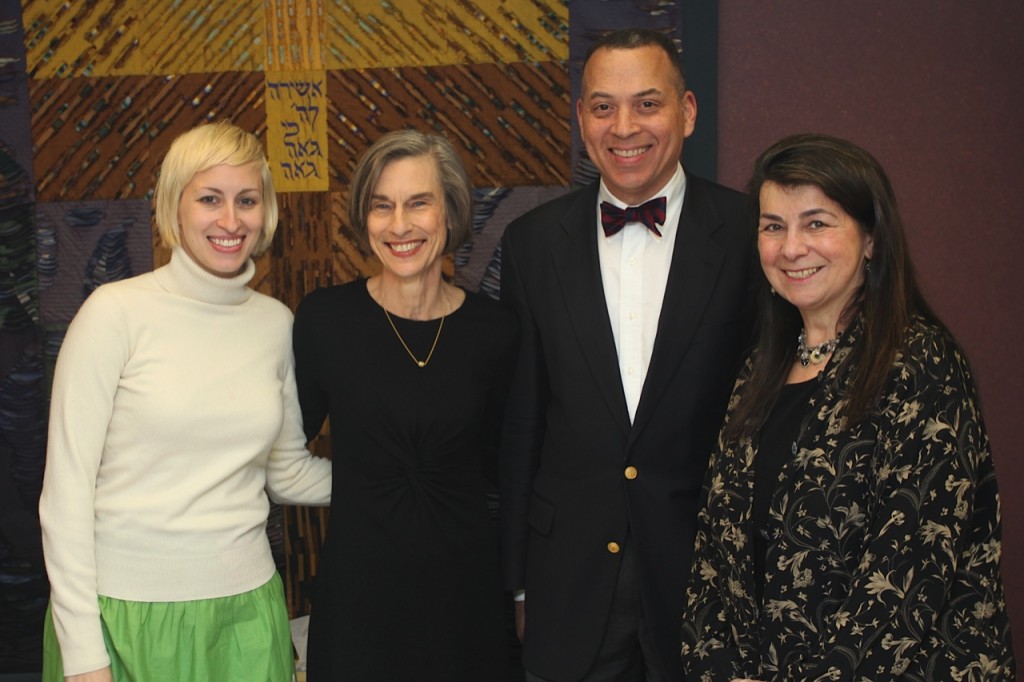
Pictured Above: Erika Scott (great granddaughter to Rosenwald), Stephanie Deutsch (author), Ralph Eubanks (Rosenwald school attendee and author, “Ever is a Long Time, a Journey into Mississippi’s Dark Past”) and Aviva Kempner (writer and director of the forthcoming film The Rosenwald Schools),
Stephanie Deutsch, historian and author, spoke at Tifereth Israel Congregation during the morning Shabbat Service on January 15, 2011. Each year Tifereth Israel Congregation organizes, over MLK weekend, a program that highlights an aspect of Jewish commitment to social justice. This year the program focused on Rosenwald Schools, the subject of Deutsch’s forthcoming book, “You Need a Schoolhouse, the Story of Booker T. Washington, Julius Rosenwald and 5,000 Rosenwald Schools.”
Deutsch gave a speech :
“The passage we are considering this morning describes dramatic events — God taking the Israelites out of Egypt, leading them with fire by night and cloud by day, through the parted sea waters and, then, when they are hungry and desperate in the Sinai desert on the other side, nourishing them with sweet water, quail and manna. It is a powerful narrative, vividly supernatural and touchingly human. In it God uses a person, Moses, to lead his sometimes reluctant, persistently grumbling or, as some translations put it, “murmuring” people, out of captivity in Egypt into the wilderness that stands between them and their ultimate destiny in the promised land of security as God’s chosen people. It is one of the most dramatic stories ever told.
It is no mere coincidence that Taylor Branch used images from this narrative as the titles for the three volumes of his history of the civil rights movement and of the man so closely associated with it, Martin Luther King, Jr. (born exactly 82 years ago today). In Parting the Waters he tells of King’s early life as the son and grandson of ministers, his embrace of the philosophy of non-violence and his leadership, as a young pastor, of the Montgomery bus boycott of 1954; Pillar of Fire covers the 1963 march on Washington, King’s memorable “I Have a Dream” speech there and his Nobel Peace Prize a year later; the story ends in At Canaan’s Edge with the dramatic march from Selma to Montgomery in support of voting rights, the mounting tension around school desegregation, and the terrible events of April 1968 that many of us remember. Black Americans have often seen in their struggle for freedom and full integration into our national life a reflection of this Jewish journey from slavery towards freedom. Civil Rights leader John Lewis, the Congressman from Georgia who marched with King, mentions in his memoir that he remembers as a child in church singing the old spiritual “Go Down, Moses” and that he felt a “kinship with the children of Israel.” The spirituals’ words reflected the understanding of slavery as a profound injustice, an offense to the Lord, and the certainty that the struggle for freedom from it would be divinely inspired, divinely sustained and, ultimately, would succeed. Lewis writes, too, that even as a child he was aware that the disdain with which he and other blacks were considered extended to Jews. In the small southern town where he grew up, they, too, were often a despised people.
Similarly, of course, many Jews have felt a particular identification with the long struggle for freedom and justice of African Americans. One such was Julius Rosenwald whose name was so widely recognized in January, 1932 that the New York Times front page carried a headline, “Rosenwald Dead, Nation Mourns Him.” Rosenwald was the son of Jewish immigrants from northern Germany, born in 1862 in Springfield, Illinois where his father and uncles ran a clothing store. He grew up attending the local public school, helping out in the family store, receiving religious education with the dozen or so other Jewish children in town. His father and uncle were among the founders of the temple there and each took a turn as president of the Brith Sholem congregation. Julius left school at 16 and moved to New York City where he apprenticed with two uncles who were manufacturing as well as selling men’s clothes.
In 1895 Julius Rosenwald was offered the chance to buy into a small, unknown mail order company called Sears, Roebuck. Despite the fact that he had just launched a different venture and that he had a wife and growing family, he sensed a good opportunity and quickly accepted the offer. With his new partner’s flair for promotion and his own meticulous attention to detail, not to mention the introduction of Rural Free Delivery and the tremendous growth in manufacturing, business was terrific. By the turn of the century Sears was selling everything from pocket watches to farm machinery and Rosenwald was soon a millionaire many times over. In his first year as a rich man he bought a big house (by this time he had five children) and increased his annual donation to the Associated Jewish Charities of Chicago so that his was the largest in the city.
Rosenwald was a member of the Sinai congregation, presided over by a dynamic Reform rabbi, Emil Hirsch, who emphasized civic engagement and a commitment to social justice as the way for modern Jews to live out their faith and this prompted Rosenwald to think seriously about how he would use his new wealth. In the summer of 1908 there had a been a shocking three days of racial rioting in Rosenwald’s home town of Springfield that left several people dead and the black part of town largely destroyed. Knowing about the pogroms Jews were suffering in Europe at the time sharpened his reaction to this. Shortly after this a friend gave him a copy of Booker T. Washington’s autobiography, Up From Slavery. Rosenwald lacked formal education but he had always had a curious and practical mind. As a Jew he was particularly sensitive to prejudice and injustice. He began to see improved racial understanding and better conditions for blacks as essential to the country’s future.
In May of 1911, when an opportunity arose for him to meet the author of Up From Slavery, Rosenwald was eager to do so. Washington was then the most widely recognized and revered black man in America. Having been born a slave on a small farm in Virginia and having literally walked from there to Hampton Institute, he had become the founder, at the age of twenty-five, of Tuskegee Institute in rural Alabama, like Hampton a training school for black teachers. Thanks largely to Washington’s tremendous energy and persistence as a fundraiser the school had become successful. Washington became famous on a national level in 1895 when he was the only black speaker at the opening ceremony for a world’s fair type exhibition in Atlanta celebrating the South’s progress since the end of the Civil War. His speech, to a large audience of prominent whites with blacks listening from the Jim Crow balcony, emphasized the good will that blacks brought to the task of developing their region and reversing, through their own efforts, the negative effect on them of generations of enforced ignorance and lack of opportunity. He suggested that in the immediate social equality was less important than opportunities for economic viability. The speech was short – about five minutes long – and it was applauded and praised by both blacks and whites. Frederick Douglass had died earlier that year and people of both races started referring to Washington as the new preeminent black leader.
Washington’s public success was mixed with personal heartbreak. His first wife, his childhood sweetheart, and his second, a brilliant teacher he had hired to work at Tuskegee, had both died leaving him twice widowed with three young children. He married a third time but spent a lot of time on the road away from home making speeches to raise money and awareness of Tuskegee. And despite the optimism he always expressed publicly, despite his honorary degree from Harvard and dinner at the White House with president Theodore Roosevelt, even as he was encouraging black people to work hard and become educated, to accept responsibility for their own fates, he knew that the treatment they were receiving from white Americans was, in many respects, getting not better but worse. The year after his speech, Plessy v. Ferguson made it legal to mandate separate accommodations for the races in trains and elsewhere. At the same time, Southern states were systematically excluding blacks from voting and the vigilante “justice” of lynching (which in my ignorance, I used to think of as an occasional, random thing) was an relentless horror. The de facto slavery of the share cropping system ensured ongoing poverty. As this continued in the first decade of the twentieth century, some blacks became harshly critical of Washington’s leadership as too timid and to refer derisively to his famous speech as “the Atlanta Compromise.”
So when they met Washington and Rosenwald knew they could be of service to each other. They also, amazingly, hit it off personally. Both were highly disciplined, organized, practical men. Each had a strong desire to do more than talk about issues. They were oriented towards action. The day after their meeting Rosenwald took Washington on a tour of the enormous Sears plant and he accepted Washington’s invitation to visit Tuskegee. Six months later, in the fall of 1911, as he would do many times in the following years, he did. These trips were amazing – each time Julius and his wife, Gussie, would fill a private train car with family members and friends, often people prominent in Chicago. Rabbi Hirsch was a guest on one trip. They would travel overnight south from Chicago, changing trains in Nashville and again in Montgomery, then riding a small railroad forty miles east through dense pine woods. It is still very rural today.
On that first visit to Tuskegee Julius and his guests, who knew almost nothing about the lives of Southern blacks, were surprised and impressed by what they say. The hilly campus was an imposing collection of red brick buildings constructed by the students of bricks they had manufactured there. Washington’s home, the Oaks, was large and gracious, surrounded by lovely gardens. It also had been built and was staffed by students. The guests stayed at a guest house in the middle of the campus, they ate meals prepared by students, visited classes, met faculty members (among them George Washington Carver, the famous researcher on peanuts). The highlight of the visit was the evening chapel service where Washington introduced Rosenwald to the students. Rosenwald spoke briefly and then the students sang spirituals. In those pre-radio, pre-sound recording days, these songs came to many white visitors as a revelation. They had never before heard the longing, the suffering and the faith the spirituals from slavery times so powerfully communicate. Julius described himself as being moved to tears.
Rosenwald agreed to serve on the Board of Tuskegee and he invited Washington to come visit him at his home in Chicago. Years ago I interviewed Rosenwald’s youngest son, William (by then a very old man) who remembered that visit and the fact that the two men spent a lot of time together talking. One result of those conversations was a plan to provide what both men agreed was one of the most glaring needs of Southern blacks, especially the huge majority of them that lived in rural areas – education. There were many places in the rural South where despite a stated government commitment to public education for both races there were no schools at all for blacks, where ad hoc classes were held in run down churches or barns, where the school term, if it existed at all, was just five months long. Washington told Rosenwald that well-built schoolhouses would have a tremendous positive impact on rural communities and that black people, who passionately desired education for themselves and their children, would contribute their own money to get them. This fit well with Rosenwald’s philosophy that it is better to teach a man to fish than to give him food. He agreed to contribute $350 for each of the first six small schools plus $50 per school for an agent from Tuskegee to go out into the countryside and talk up the project, engage the commitment of the local school board, and solicit donations from whites and blacks – a kind of community organizer if you will.
The school building program created by Washington and Rosenwald resulted over the next twenty years in the construction of almost five thousand schoolhouses that became part of the public education systems in fifteen states and educated about a third of the African American children in the South. Because they were built using contributions from local people and because, in many places they were the only facilities where blacks could gather, the schools became sources of great pride in their communities. They are called “Rosenwald Schools” but the name is a misnomer. Rosenwald’s financial contribution was just fifteen percent of the schools’ total cost. The bulk of the money that built them came from the state governments that became their proprietors. A sum slightly greater than Rosenwald’s gift came from people, most of them poor, most of them black, people who had already paid taxes that should have provided them with schools – people who gave money, land, building materials, food for work days and vital commitment and energy.
Today all across the South that energy is at work again in the effort to preserve Rosenwald schools. In the wake of Brown v. Board of Education, which struck down school segregation as unconstitutional, as school systems moved to consolidate (with agonizing slowness in some places), they rarely chose to put the newly integrated classes in facilities that had been black schools. The Rosenwald schools that small black communities had worked so hard to create and then to maintain became obsolete. For a time they were forgotten and some fell apart, vanished. Others stood empty and unused for years.
In the past twenty years, though, a movement has sprung up to reverse this trend. In many small towns and communities all across the south, groups of alumni are working to preserve Rosenwald schools and the history these small structures so powerfully communicate. Like Jews recalling the Exodus at Passover, they are reliving the story of their communities’ dedication to the ideal of education as the path that would lead them from the wilderness of poverty and ignorance to a place of justice and equality. They are again coming together, this time with the goal of preserving their heritage by reclaiming the buildings that were Rosenwald schools.
Today’s reading from Exodus ends with the Israelites reaching, at last, the edge of the land of Canaan. Just as the Taylor Branch trilogy concludes, in the volume of that name, with the assassination of Martin Luther King, so our Torah portion ends with conflict – the attack of AHmalek and the ferocious battle that ensues. God has been with the Israelites, providing everything they need to survive but even so, enemies abound. They must be fought and defeated again and again. In the case of our American push towards a more fully realized expression of our ideals of freedom and equality, the story does not end with the significant accomplishments that grew out of Julius Rosenwald’s imaginative philanthropy, of Booker T. Washington’s dignity and determination, of Martin Luther King Jr.’s inspired leadership. But the work of these three men can be seen as manna in the wilderness and sweet water in the desert, a reminder of God’s loving presence with us, sustaining us always, propelling us forward towards the fair and just society which we believe reflects God’s will for us and to which we aspire.”

Recent Comments